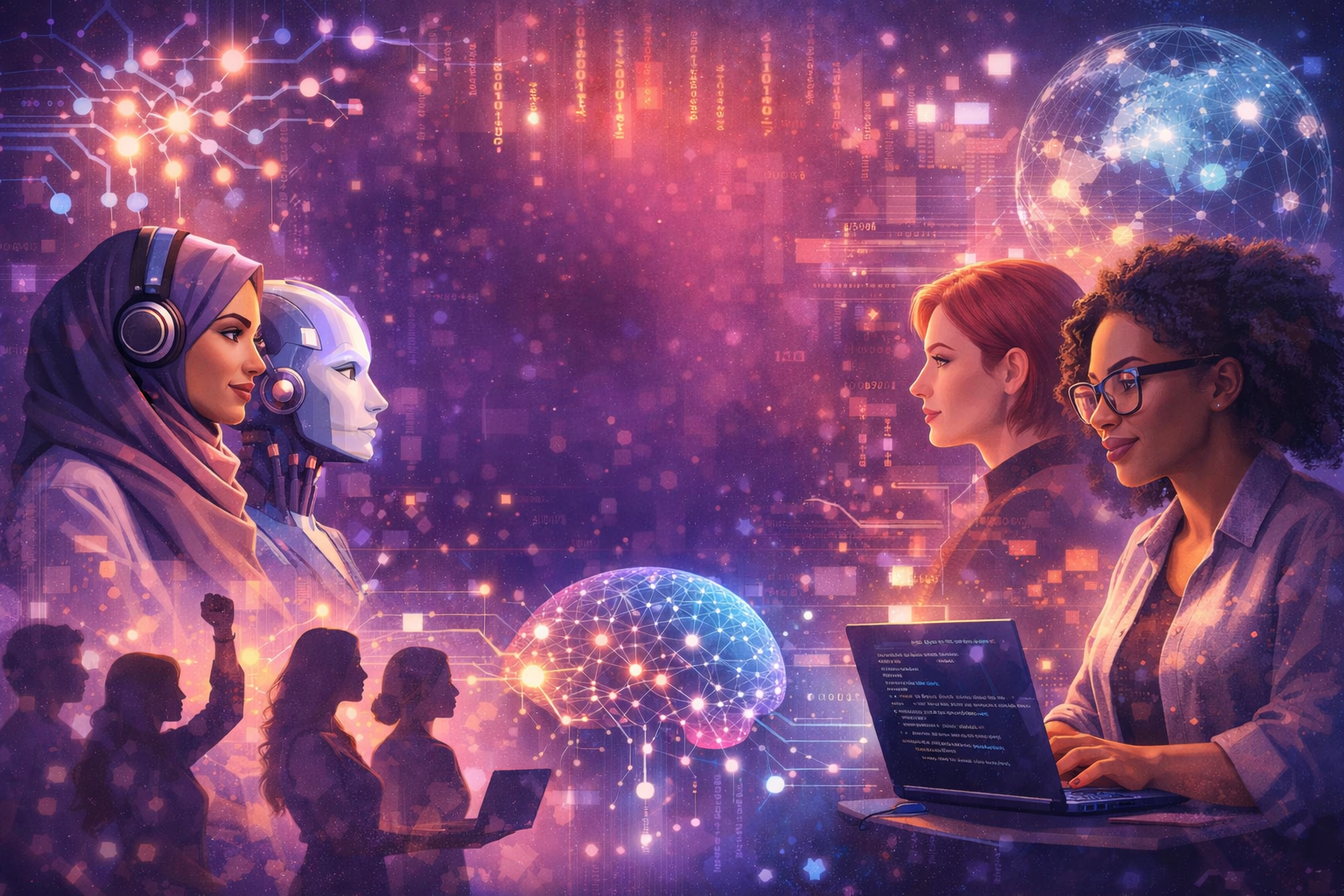
Women in Computer Science · AI · Data Analytics
From scarcity to supercomputers — the story of women who refused to be written out of the code that is reshaping our world.
Introduction
Before computers filled skyscraper data centers, before language models could write sonnets, before algorithms diagnosed diseases — there were women. Women who hand-calculated the trajectories of rockets, women who wove the first programming concepts into existence, women who stared at blank terminals and imagined what the machines could become. And yet, somewhere along the way, the story got edited. Women were cropped out of the frame.
Today, the narrative is being rewritten — one dataset, one model, one PhD thesis at a time. Across the globe, women are not just participating in the fields of computer science, artificial intelligence, and data analytics. They are leading them, questioning them, and making them more human.
This is a story about that journey. About the long road that brought us here, the pioneers who lit the path, and the remarkable moment we now stand in — where a girl in Karachi with a laptop and a Wi-Fi connection can access the same tools that were once locked inside billion-dollar labs.
These words could belong to thousands of women who entered computer science from underrepresented corners of the world. From Pakistan to Nigeria, from rural India to Eastern Europe — the story of women in tech is also, inevitably, a story of doing more with less.
The Numbers
The gap is real — but so is the momentum.
Personal Narrative
When she began her studies in computer science in Pakistan, she could count the women in the room on one hand. The internet was intermittent. High-performance hardware was a distant dream. Running even modest machine learning experiments required access to systems that simply weren’t available locally. And yet, the problems she wanted to solve — using AI to read medical images, to catch what the human eye might miss, to save lives in places where specialists were few — were too urgent to wait.
That researcher went on to earn a Master’s degree in Robotics and AI, then a PhD specializing in AI for medical imaging. Today she is an active researcher, sitting at the intersection of artificial intelligence, healthcare, and business intelligence — asking questions that matter and building systems that answer them.
What changed? The world did. And it changed fast.
Tribute
Science moves on the shoulders of those who came before. Here, we honor one of the most pivotal figures in modern AI.
She arrived in the United States at 16, speaking little English, working in a Chinese restaurant and a dry-cleaning shop to help support her family. She could not have known that she would one day be called the Godmother of AI.
Fei-Fei Li’s creation of ImageNet — a dataset of over 14 million labelled images — is not a footnote in AI history. It is the chapter that made modern deep learning possible. Before ImageNet, neural networks were clever ideas. After it, they became the engine of a revolution.
Beyond the technical contribution, Fei-Fei Li has used her platform to argue, consistently and loudly, that artificial intelligence must be built by diverse minds — or risk embedding the biases and blind spots of the few into the decisions of the many. She founded AI4ALL, a nonprofit dedicated to bringing underrepresented youth — particularly girls — into AI education.
For researchers who follow her work, she is not just an inspiration in the abstract. She is proof that where you start does not determine where you arrive.
The Turning Point
There is a generation of women entering computer science, AI, and data analytics today who have never known the world without Stack Overflow, without GitHub, without the ability to pull a pre-trained model from Hugging Face and fine-tune it in a free cloud notebook in under an hour.
This is not a small thing. This is a seismic shift in who gets to participate in building the future.
The old barriers — access to hardware, access to expensive textbooks, geographical isolation from research centers — are not gone. But they are smaller than they have ever been. And in their place, new communities have emerged: Women in Machine Learning (WiML), Girls Who Code, AI4ALL, Black in AI, Deep Learning Indaba, and dozens of regional collectives turning what used to be solo struggles into collective momentum.
The question is no longer whether the tools exist. The question is whether we are doing enough to make sure girls know they exist — and that these tools were built for them too.
If you are reading this from a bedroom in Karachi, Lahore, Lagos, Dhaka, or anywhere else that the world sometimes forgets to include in its maps of innovation — this paragraph is for you.
The researchers who are now shaping how AI diagnoses cancer, how algorithms decide who gets a loan, how machines learn to see — many of them started exactly where you are. With curiosity and not much else.
You do not need a perfect setup. You do not need to be from a famous university. You do not need to be the only one who looks like you in the room — though you may be, for a while, and that is its own kind of strength.
What you need is this: the willingness to start. The stubbornness to continue. And the understanding that every model you train, every insight you uncover, every paper you publish makes the room a little less empty for the girl who comes after you.
The algorithm needs you. More precisely — we need you to run it.
Conclusion
Computer science, artificial intelligence, and data analytics are not neutral fields. They are shaped by the people who build them, the questions those people think to ask, and the blind spots they carry without knowing it. A field built without women is a field that will produce systems that fail women — and everyone else.
The history is imperfect. The present is unequal. But the direction of travel is clear: more women are entering these fields, rising within them, and reshaping what they look like from the inside. Researchers working on AI in medical imaging. Engineers building more equitable data systems. Scientists asking not just “what can this model do?” but “what should it do, and for whom?”
The women who came before us proved that belonging here was never the question. The question was always whether the field was ready for what we would bring to it.
It is getting there.
About the Author
Dr. Sumaira Awan
· Software Engineer · MS in Robotics & AI · PhD in AI for Medical Imaging
Active researcher at the intersection of artificial intelligence, healthcare, and business analytics.